


Who? (1897) Nikolay Kasatkin
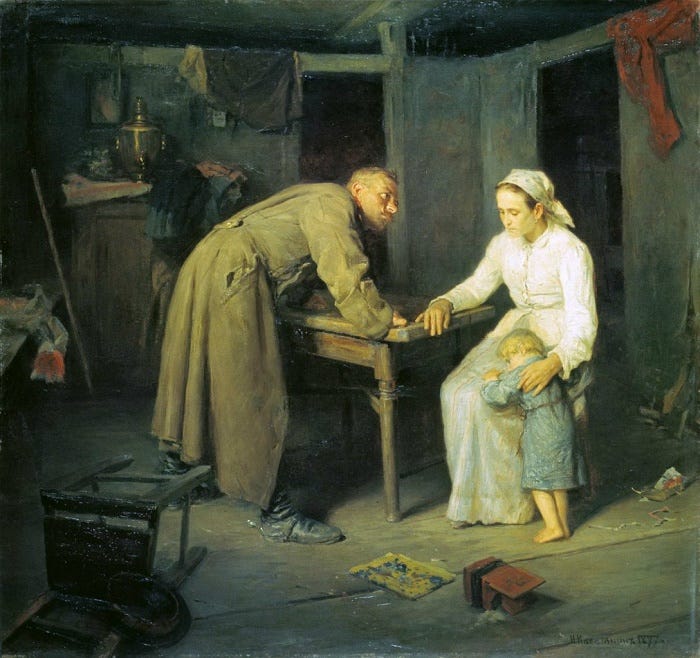
Some time ago, I came across the work Who? (1897) by Nikolay Kasatkin almost by chance. At the time, I did not know who the artist was, nor the historical context in which the painting had been created; however, the image stopped me. There are scenes that do not impose themselves through explicit drama, but through the sadness they leave behind: a tense silence, a lowered gaze, an encounter that seems to carry something that cannot be said. In Who?, nothing happens in a visible way, yet everything seems to have already happened.
From that moment on, the painting deeply captured my attention, and the desire arose to understand what the work is trying to tell us between brushstrokes. This essay proposes to share a reading of the painting that begins with its historical and social context and then turns to a careful observation of the scene itself, understanding that only from there is it possible to move away from rushed interpretations, such as reproach or betrayal, and instead recognize a story marked by absence, lack of protection, guilt, and violence. Rather than offering a closed answer, this analysis seeks to accompany the question that gives the work its title and to explore the silence that follows it.
Context
Before delving into the analysis of the work itself, it is necessary to become familiar with the painting, its author, and its context.
Nikolai Alekseyevich Kasatkin, born on December 13, 1859, in Moscow and deceased on December 17, 1930, was a Russian painter considered one of the founders of social realism in Russia.
But what is social realism? Social realism is a term associated with an artistic movement whose purpose was to make social problems visible and to emphasize them through the representation of everyday life. Its artists focused their attention on the daily conditions of the working class and disadvantaged sectors, portraying situations of poverty, precarity, and inequality, while also strongly criticizing the social structures that sustained and perpetuated these conditions.
It is important to note that, unlike social realism understood in a general sense, which often limits itself to representing the lives and material conditions of the lower classes, Russian social realism is characterized by a marked ethical dimension. It is not merely about showing poverty or suffering, but about questioning the structures that produce them. Within this framework, intimate scenes cease to be read as private conflicts and instead become symptoms of a social order that exposes the most vulnerable bodies. The work of Nikolay Kasatkin fully belongs to this tradition, in which restrained gestures and silence acquire greater expressive force than explicit action.
In much of the social realism developed in Western Europe, the figure of the worker and the space of labor occupied a central role as symbols of social injustice. Scenes were often set in factories, fields, or workshops, emphasizing physical effort, labor exploitation, and material living conditions. Although women appeared in these representations, they often did so in secondary or stereotyped roles. In contrast, Russian social realism significantly broadened what could be represented, incorporating domestic life, intimate relationships, and experiences of vulnerability that do not always manifest in the public sphere. In this way, the figure of the woman and the silent consequences of poverty, war, vulnerability, and normalized violence became central axes of a social critique that no longer limits itself to labor, but extends into the private sphere.
Within this same historical and social context, late nineteenth-century Tsarist Russia was marked by strong militarization. Mandatory military service particularly affected men from the lower classes, who could be sent far from their homes for long periods of time. This forced absence not only meant the loss of economic support, but also the disappearance of a figure of protection in a deeply unequal and patriarchal social environment. For many women, being left alone meant extreme vulnerability, exposure to precarity, social judgment, and various forms of violence that rarely received recognition or denunciation. Added to this was the scrutiny and abuse women faced simply for being women. From this perspective, war does not appear in Kasatkin’s work as a visible event, but as an indirect presence that leaves deep marks on domestic life and on the bodies of those who remain. War ceases to be a purely military event and enters the home, separating families and forcing them to endure harsh realities.
The Painting
The painting presents an interior scene that is austere, dark, and broken. We see a house that is disordered and dirty, almost as if it were falling apart. It has perhaps not been a home for many years, likely since the man left for war.
Three figures concentrate all the tension of the composition. On one side, a woman holds a small child in her arms. Facing her is a man who has just returned, a soldier. There is no physical contact between them, nor are there explicit gestures of confrontation. The scene is constructed through distance, silence, and suspended movement. Everything seems frozen in a moment before speech, as if the painting captures the exact instant in which the story has not yet been spoken, but already weighs heavily on the bodies.
At first glance, the painting suggests that the soldier has returned home only recently. He is still wearing his military clothes, and his body conveys exhaustion. He appears to have discovered something that drives him to abruptly rise from his seat and approach the woman with a gesture that could initially be read as inquisitive. The child she holds does not resemble him. He does not share his features or his blond hair, and his age does not seem to align with the length of time the man has been away. This combination of elements invites an immediate reading centered on infidelity.
The Soldier
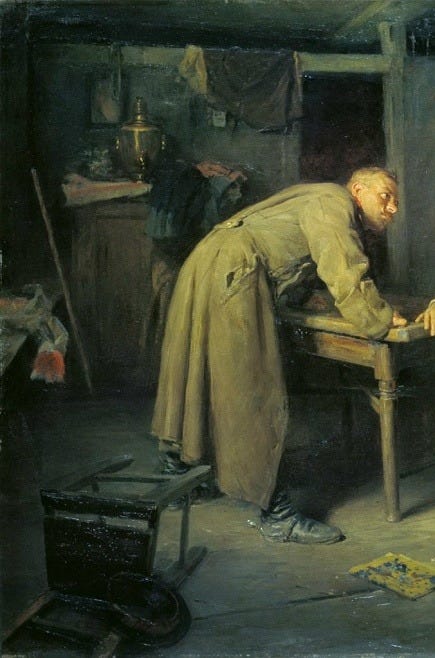
However, when the scene is observed more closely, the interpretation of reproach begins to collapse. The man’s posture is not that of someone who bursts in or accuses. He does not advance violently, point, or invade the woman’s space. He does not stand upright in an accusatory manner; in fact, he bends down, seeking to be at her eye level.
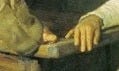
We can pause for a moment on his hands. They move toward those of his wife, but they do not touch her. They seek closeness but do not impose it. His body appears still and restrained, as if the event did not bring with it the possibility of reproach, but only a belated awareness of what has occurred. The sadness of not having been there. Time has done its work in that distance.
The expression on his face does not convey anger toward his wife, but rather a silent sadness, a fatigue that is not directed at her, but at a situation that can no longer be undone. He appears worried, frightened by the fact that he was unable to be there for her, by seeing her suffer. He questions her in search of an answer, an answer from the one who remained in his absence.
This gesture is key to the interpretation of the scene. Far from embodying the figure of a judge or a betrayed husband, the man appears as someone who understands, even if painfully, that his absence had irreversible consequences within a violent society. In this sense, he can be read as a figure ahead of his time: he understands that the woman is not responsible for what occurred, but rather its victim. His return does not restore the lost order; it only confirms the lack of protection that existed while he was away. He now seeks to offer protection once again, while fearing that it may be too late.
The Child
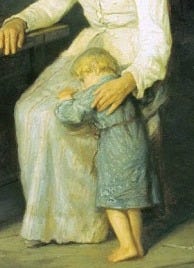
The presence of the child occupies a central place in the scene, not because of his actions, but because of what he reveals. His small body, with features that do not match those of the man, held in the woman’s arms, introduces a temporal dimension that destabilizes the reunion. The child seems too young to correspond to the man’s period of absence. This is not an anecdotal detail, but a silent mark of the passage of time and of what occurred while he was gone. The child does not accuse or explain. He simply exists, as an undeniable piece of evidence.
Added to this is the child’s own expression. He appears frightened by the man standing in front of them. He does not recognize him. His body responds cautiously to an unfamiliar presence, without gestures of familiarity or trust. He is barefoot, a detail that emphasizes his vulnerability and exposes the precariousness of the environment, while at the same time contrasting with the visible care of his appearance and the bright colors of his clothing. Despite the modest setting, his clothes appear clean and orderly, as a sign of the mother’s effort to protect him and preserve his dignity even under adverse conditions.
The child does not appear as a sign of betrayal or reproach, but as the visible consequence of a prolonged absence and, at the same time, as proof of a persistent love. His fear does not trigger violence; instead, it deepens the silence that permeates the painting and raises concern about what they have had to endure over the past years.
The Woman
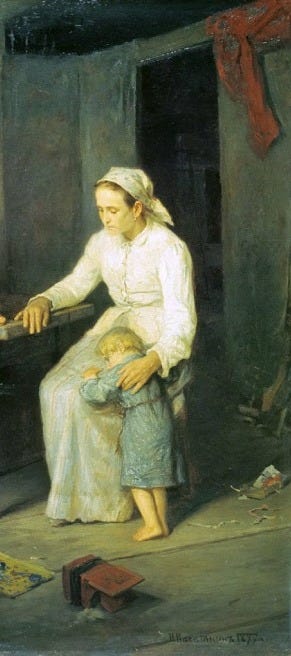
The figure of the woman is not constructed through tension or bodily fear. On the contrary, her posture reveals a restrained yet open disposition. Her body leans slightly toward the man, not as a defensive gesture, but as an approach marked by sadness, her chin lowered and her shoulders slumped, carrying a weight that silence conceals. She wants to speak to him, but knows it will be painful. There is no rigidity or rejection. What is perceived is a painful stillness.
Once again, it is important to examine the position of her hand. Far from hiding or withdrawing it, the woman keeps it open, close to the man’s, willing to take it again. This gesture suggests a bond that has not been denied, but suspended. However, the hands do not touch. Between them remains a minimal yet significant distance, concentrating the question that runs through the scene. Something stands between them, something that has yet to find words.
To this bodily reading we can add that the woman is dressed in white, a color traditionally associated with purity and innocence, which contrasts with the darkness and muted tones dominating the rest of the space. Her hair does not cover her face. She wears a headscarf that frames it and allows her to be clearly seen. This detail is significant: the woman does not hide or conceal herself from the man’s gaze. She knows she is not guilty. Her face is exposed, visible, available to be read.
These visual elements do not reinforce the idea of guilt, but rather displace it. The woman is not presented as responsible for what occurred, but as a figure marked by the consequences of an absence that left her exposed, at a time when, if you did not have a man by your side, you were nothing.
On the other hand, the light does not fall exclusively on her. It also reaches the man, partially illuminating his figure and establishing a visual continuity between them. This choice avoids a simplistic moral reading and reinforces the idea of shared sadness. Neither of them is left in the shadows. The lighting does not assign blame, but instead makes visible the distance that separates them, a distance shaped by time, absence, and their consequences.
The Question That Remains
Thus, the question that gives the work its title, Who?, does not ask “who did you cheat with?”, but rather “who failed?”, “who was not there?”, “who allowed this to happen?”. More importantly still, another question emerges: “who did this to you?”. The question remains suspended in the space between the hands that do not touch, reminding us that there are forms of violence that are not shown, yet leave deep marks, and that the true conflict is not always found in visible gestures, but in what occurred when no one was watching.
The work shows us the consequences of prior harm without representing violence explicitly. Kasatkin does not depict the violent act, but its aftermath: a female body that has endured an experience it did not choose, a child who bears witness to that wound without understanding it, and a man who returns too late to prevent it. The burden is not carried solely by the one who suffered the abuse, but also by those who could not prevent it, those who learned too late, those who must watch their loved ones endure pain. All of them, in different ways, are victims of a society that abandons, of a dominant masculinity, and of a life shaped by precarity. Because violence is not only warlike. It is not seen only on the battlefield. It also inhabits everyday life, infiltrates domestic spaces, and reveals itself in silences, absences, and restrained gazes, behind the dark curtains of a house that can no longer protect.
Bibliography
Soviet Russian painter Nikolay Kasatkin 1859–1930. n.d. January 2026.
https://soviet-art.ru/soviet-russian-painter-nikolay-kasatkin-1859-1930/
Nikolai Kasatkin. n.d. January 2026.
https://www.rusartnet.com/biographies/russian-artists/19th-century/late-19th-century/realist/nikolai-kasatkin
And now, dear readers, do you see the same silence, the same distance, the same shared burden?
Or does the painting reveal something different to you, another gesture, another story, another question that I may have missed?
I’m always glad to read you <3
Thank you for reading me and my first essay on this site.
-Love, Mandy.
What an opening essay! As someone who has wanted to delve more into the art world, this was so educational and written with such care. Thank you for writing it!
It's a fascinating analysis of an art piece that could easily be brushed aside, thinking that "Yeah, the woman cheated on him." You have a keen eye for detail, and your interpretation allowed me to look at the tragedy from new angles. That's a great essay to be published first on Substack!